Victims of childhood sexual abuse would no longer face legal deadlines regarding how long they have to seek damages from their abusers, under legislation state Sen. Terry Link passed out of the Illinois Senate this week.
“I don’t know how you put an expiration date on being scarred for life,” Link said after his legislation, Senate Bill 1399, was approved 48-4. It now advances to the Illinois House for further consideration.
Current state law imposes a 20-year deadline for a sexual abuse victim to file a lawsuit against the abuser. More specifically, the victim has 20 years from the date that he or she knew of the abuse to go to court.
Link’s plan simply eliminates that deadline so a victim could sue for damages at any time.
* Attorney General Lisa Madigan has asked the US Supreme Court to grant an extension in the concealed carry case. Read the filing by clicking here.
Madigan has to file her petition for certiorary by May 23rd, while the spring session is still in session and several days before the June 9th appellate court deadline is imposed on the state. She’s asking for a 30-day delay.
Gov. Pat Quinn is listed on the request as a petitioner. Quinn has publicly urged Madigan to file an appeal.
From the AG’s office…
The June 9 deadline still stands for the legislature to act. This filing doesn’t impact that.
What this filing does is allow us more time to prepare a petition, and to the extent the legislature takes action before June 9, it allows us to take that action into consideration as we draft a petition for review as the Attorney General continues to assess the appropriate next steps.
* Former Illinois Supreme Court Justice Moses Harrison passed away last week. This is his career defining quote…
“People often ask how I see my role as a judge. It is to protect ordinary citizens against wrongdoing by the government, large corporations and powerful individuals.”
In a 2002 Supreme Court news release announcing his retirement, Harrison said his small-town upbringing in Collinsville instilled within him a philosophy that “the reason for our existence is to help other people.”
One of the more well-known dissents Harrison delivered came in November 1998, when he wrote that the state’s death penalty was unconstitutional because “the execution of an innocent person is inevitable.”
About three months later, according to the court’s 2002 release, Death Row inmate Anthony Porter was exonerated and released after someone else admitted to the murders that put him behind bars.
“There are some who say Chief Justice Harrison was the first to call for a stop to executions in Illinois,” the court’s 2002 release states.
Not even a year after Harrison issued a public statement in 1999 that said the governor had the constitutional power to stop executions, the release notes that former Gov. Ryan issued a moratorium on the state’s death penalty.
Memorials may be made to St. Michael’s Episcopal Church, 111 O’Fallon Troy Road, O’Fallon, IL, 62269, or the Justinian Society of Lawyers Scholarship Fund, 734 N. Wells St., Chicago, IL, 60610.
“When you look precinct by precinct, you see the impact that John Hartman had,” Gill told me last week. “I would have won by at least a point and a half had there not been a John Hartman.”
Yeah, and if Davis wasn’t on the ballot, Gill would’ve won by a landslide.
Whatever.
He was a weak candidate. End of story. If Gill runs again and wins the primary, he’ll be a weak candidate again.
* As I told subscribers last week, the DCCC is pinning its hopes on the chief judge of the 3rd Judicial Circuit Ann Callis…
Callis was in a similar situation before. Two years ago Democrats tried to talk her into running in the 12th Congressional District, for the seat that had been held by former U.S. Rep. Jerry Costello, D-Belleville. She took a pass that time — “I came to the conclusion that at this time, I could not leave a community that I love, employees and colleagues of Madison County Circuit Court that have become like family to me,” she said — and the seat eventually went to Rep. William Enyart, another Democrat.
But Democrats now want her to run in Davis’ 13th Congressional District, even though her home outside of Troy is in the 15th District represented by Rep. John Shimkus, R-Collinsville. […]
As the chief judge in the 3rd Judicial Circuit, she has name recognition in several counties in the southern end of the district, she has contacts and money (she self-funded her campaign for judicial retention last year and her father, Lance Callis, is a Granite City trial lawyer who made millions by investing in the Argosy Casino in Alton, then selling his shares in 2005) and she has a good reputation.
Callis can self-fund, which is a big plus for the DC folks. Expect an announcement soon.
* Former state Senator Rev. James Meeks appears in a new robocall aimed at African-American voters. Meeks encourages people to call their Illinois House members and demand they vote against the gay marriage bill. Listen…
“The [African-American Clergy Coalition] has begun distributing fliers to Cook County African American Churches,” a release from the AACC said today. “African American Clergymen have now taken the AACC flier and began instructing their Congregations to call their legislators.”
The fliers contain a list of African American House members with their phone numbers.
Direct lobbying by pastors in their churches seems pretty darned close to the line. Click the fliers for a larger view…
* In other news, Carol Marin writes about House Republican Leader Tom Cross’ stance on gay marriage…
Inside Cross’ caucus of 47 Republicans, David Harris and most others will vote “no” when the time comes. Only two Republicans, Ron Sandack of Downers Grove and Ed Sullivan of Mundelein, have publicly voiced support for same-sex marriage. And they’re reportedly taking a huge amount of heat from some GOP brethren because of it.
Enter Cross.
“I’m trying to balance . . . and respect the wishes of a whole caucus . . . at the same time trying to remind everybody in our caucus that there are folks who are for this. You have to respect them,” he said by phone on Friday.
The ironies abound.
Some of the downstate members of Cross’ caucus who invoke their conservatism in opposing gay marriage don’t seem very conservative at all when it comes to pension reform. On that issue, they seem to have found common ground with their liberal Democratic colleagues, dependent as many of them are on the support of public employee unions.
* Rhode Island Beats Illinois To Gay Marriage: The risk of a black lawmakers losing his seat seems minimal, though. They can’t lose their seats to Republicans, and in 2014, is any Democrat going to run a primary campaign on the issue of opposing same-sex marriage? The winner wouldn’t have a lot of friends in the House Democratic Caucus. More likely, a black legislator trying to move up to alderman, county board, state senate or Congress would be denied a Sunday appearance at a conservative black church. That’s a valuable endorsement in the black community, so that may be enough to make a politician hesitate before pressing “yes.”
Monday, Apr 29, 2013 - Posted by Advertising Department
[The following is a paid advertisement.]
Cooperatives can be formed to support producers such as farmers, purchasers such as independent business owners, and consumers such as electric coops and credit unions. Their primary purpose is to meet members’ needs through affordable goods and services of high quality. Cooperatives such as credit unions may look like other businesses in their operations and, like other businesses, can range in size. However, the cooperative structure is distinctively different regardless of size. As not-for-profit financial cooperatives, credit unions serve individuals with a common goal or interest. They are owned and democratically controlled by the people who use their services. Their board of directors consists of unpaid volunteers, elected by and from the membership. Members are owners who pool funds to help other members. After expenses and reserve requirements are met, net revenue is returned to members via lower loan and higher savings rates, lower costs and fees for services. It is the structure of credit unions, not their size or range of services that is the reason for their tax exempt status - and the reason why almost three million Illinois residents are among 95 million Americans who count on their local credit union everyday to reach their financial goals.
* As Doug Finke points out, there’s an awful lot to do in the next five weeks…
The deadline has now passed for the House and Senate to act on bills that started in their respective chambers, marking the halfway point in the process. Let’s see where some big things stand.
The state budget? It’s not May yet, so of course it’s nowhere to be seen. Outside, that is, of Gov. PAT QUINN’s budget that was outlined in March and hasn’t been heard of since. Even Quinn’s budget probably wouldn’t be out there if the state Constitution didn’t force him to do it. Bzzzt. (Cue the penalty buzzer).
Gambling expansion with its lure of easy new millions for the state? Hasn’t’ passed either chamber. Bzzzt.
Concealed carry seems headed toward the state in one form or another after a court-ordered deadline of June 9. Surely the legislature has acted to put its stamp on that, right? Nope. The House has debated and voted on two concealed-carry bills — one restrictive, one not — and rejected both of them (guess they get points for consistency). That still puts the House ahead of the Senate, which has yet to publicly debate and vote on any concealed-carry bill. Bzzzt.
Compared to all of that, there’s been an explosion of activity on pension reform. The Senate actually passed a reform bill (on the second try) dealing with one of the five systems. The House has passed three reform bills over to the Senate.
Unfortunately, none of that stuff is the final version of pension reform. Plus, it all passed before the spring break that ended April 5. Since then, nothing
Brown, in his second term in the House, is sponsor of HB 2496, a bill to provide state incentives to help lure a $1.2 billion fertilizer plant to Tuscola, a project that would be an economic boon to East Central Illinois. Iowa also is competing for the plant.
Brown had lined up two dozen co-sponsors for the measure, met with House leaders, the governor and others, got the bill out of committee unanimously and thought it was in good shape for passage.
“It was getting extremely close to being called. We had a meeting with Speaker (Michael) Madigan, (Democratic Leader) Barbara Flynn Currie and (Republican Leader Tom) Cross where we sat down and discussed all the issues at hand. They indicated they were supportive,” Brown recalled.
“And then a couple days later, John Bradley filed Amendment 3.”
Amendment 3 forgives a $15 million state loan to the Chicago Port Authority that was made 25 years ago.
The odd thing is that Rep. John Bradley is from Marion, about 310 miles from the offices of the Chicago Port Authority. But Bradley is also among Madigan’s assistant leaders.
The amendment was approved in a voice vote on the House floor, so now it’s part of Brown’s bill for the Tuscola fertilizer plant, a bill that was seemingly headed for approval. Now his bill is on hold.
“I tried to remove it,” Brown said. “But it turned out that wouldn’t work out.”
A pattern is developing in the House of holding off on all the goodies until the hard stuff is passed. Brown is a conservative, but he’s against pension reform. He’s also a likely “No” vote on the budget. The thinking may be to not give him what he wants for his district until after the hard stuff has passed.
But that means a ton of legislation (far more than listed above) is backlogged. It’s gonna be a crazy May. Either that, or nothing will get done.
* Related…
* Editorial: Don’t give state more money to throw away
A new statewide poll shows a majority of Illinoisans favor concealed carry. But an overwhelming majority in every area of the state also say it’s OK with them if Chicago and Cook County police have additional authority over who gets to carry in their own jurisdictions.
The Capitol Fax/We Ask America poll of 1,284 likely voters found that 52 percent say they approve of allowing concealed carry.
“Illinois lawmakers are debating proposed laws that would allow some citizens who are properly licensed to carry concealed firearms,” respondents were told. “In general, do you approve or disapprove of allowing licensed citizens to carry loaded, concealed firearms?”
The poll, taken April 24th, found that 46 percent disapprove and just 2 percent were neutral or had no opinion. The poll had a margin of error of +/-2.7 percent. 26 percent of the numbers called were cell phones.
Geography breaks down pretty much how you’d expect. Chicagoans staunchly opposed concealed carry 69-29, while suburban Cook County voters opposed it 52-46. Downstaters strongly support the proposal 67-32 and collar county voters support it 53-46.
Women disapproved of the idea 55-43, while men supported it 64-34. Republicans backed it 72-26, Democrats opposed it 65-34 and independents favored it 61-36. African-Americans opposed the idea 61-36, but whites backed it 56-43, as did Latinos, 56-43.
The results for the poll’s second question were even more interesting.
The Senate is currently considering a plan that would allow Chicago police and the Cook County Sheriff to reject State Police-issued concealed carry permits if they have questions about the applicants’ character. The plan stalled last week when Republican Senators balked after strong National Rifle Association opposition and Chicago-area Democrats demanded more restrictions in the rest of the bill.
But the voting public absolutely loves this idea, with a whopping 73 percent voicing their approval. “I can’t get 73 percent of people to agree that it’s dark at midnight,” joked We Ask America pollster Gregg Durham last week.
“If a concealed carry law is passed, Chicago and Cook County law enforcement officials want the right to stop a permit being issued to any individual in Chicago or Cook County when there is a concern about the applicant’s character,” respondents were told. “Do you think they should be able to stop a permit in Chicago or Cook County under those circumstances?”
A mere 22 percent disagreed with the proposal and only 5 percent were neutral or had no opinion.
The results didn’t surprise Sen. Kwame Raoul (D-Chicago), who is attempting to craft a compromise bill. Raoul said he believed that Downstaters don’t care what happens in Chicago or anywhere else as long as they get their right to carry. And Chicagoans are so concerned about guns that they want their local cops to have an extra say.
According to the poll, a hugely strong 71 percent of likely Downstate voters said they approved of the plan, while 25 percent were opposed. The NRA has threatened legislators with retaliation if Chicagoans don’t end up with the same access to concealed carry as everyone else, but that particular message may not fly as long as Downstaters get what they want for themselves.
Even so, Downstaters seem to be sticking with the NRA. “I am working to pass a Concealed Carry law that specifically says it SHALL apply to all counties in Illinois,” state Sen. Kyle McCarter (R-Lebanon) wrote on his website last week. “The Second Amendment of the Constitution applies [to] all citizens, including those in Chicago.”
But a sky-high 80 percent of likely Chicago voters approved of the proposal, as did 72 percent of suburban Cook voters and 71 percent of collar county voters.
Support was also very high across all demographics. Women were 80-14 in favor, and men were 62-32 in favor. Black voters backed it 75-16, whites supported it 65-34 and Latinos approved of it 75-18. Republicans supported it 64-30, Democrats favored it 82-13 and independents backed it 67-23.
Results like that could make you think this ought to be a no-brainer issue. But the NRA is bringing all of its considerable might to the table here, and that muscle is, so far, outweighing overwhelming public opinion.
Subscribers have crosstabs.
* Related…
* Quinn: Cities, not state, should approve concealed guns: Sen. Tim Bivins of Dixon, the Republican negotiator on the issue, supported Raoul’s idea of a “compromise” giving Chicago more authority if carry permits were more readily available to lawful gun owners in the rest of the state. But he was much more cautious late last week after seeing the proposed language. A more widespread local option is out of the question, the former Lee County sheriff said.
George Jones, known as “the greatest voice in country music,” died today at a Nashville Hospital after being hospitalized last week with a fever and irregular blood pressure, his publicist said today. He was 81 years old. “The world has lost the greatest country singer of all time,” his friend Merle Haggard said in a statement to Rolling Stone. “Amen.”
Born in Saratoga, Texas into an extremely poor household, Jones went on to 143 Top 40 country hits; fourteen went to Number One, beginning with 1959’s “White Lightning,” and they continued through the decades including “She Thinks I Still Care” and “He Stopped Loving Her Today.” Sinatra called him “the second greatest singer in America” (second only to himself) while Keith Richards calls him “a national treasure.” “If we all could sound like we wanted to, we’d all sound like George Jones,” Waylon Jennings once sang.
“Most people’s voices are a gift from God,” Garth Brooks once said. “With George Jones, I think it started out as a gift from God and then they built a body around it because anybody who has ever wanted to sing country music wants to sound like George Jones.”
* Here’s one from last year with George, Jamey Johnson and Blackberry Smoke singing “Yesterday’s Wine”…
You give the appearence
Of one widely travelled
I’ll bet you’ve seen
Things in your time
Calvin Sutker devoted much of his adult life to politics — as chairman of the Illinois Democratic Party, Cook County commissioner, state representative, Skokie trustee — and for 33 years, the Niles Township Democratic committeeman.
But he spent his last decade speaking to community groups about his experience as a young soldier who witnessed firsthand the horror of the Dachau Nazi concentration camp in southern Germany.
“We were sickened at the ghastly spectacle of the depravity of the Nazi perpetrators,” Mr. Sutker said at a 2003 Kristallnacht observance marking the Nov. 9, 1938, night when Nazis destroyed thousands of Jewish businesses.
“He had never spoken publicly about it before that day,” said a daughter, Sharon McGowan.
A longtime Skokie resident, Mr. Sutker died Thursday morning, a few weeks before his 90th birthday, at Evanston Hospital.
Mr. Sutker met his late wife, Phyllis, when he delivered an order from his father’s Austin deli and grocery to her home — an event orchestrated by her mother. […]
Visitation will be at 12:45 p.m. and a funeral service at 2 p.m. Friday at Ezra-Habonim, the Niles Township Jewish Congregation, 4500 W. Dempster St., Skokie. Burial will be in Westlawn Cemetery, 7801 W. Montrose, in Norridge.
You can watch Sutker talk about his experience at Dachau by clicking here.
Gov. Pat Quinn’s administration has cut off funding to the state’s largest charter-school operator, the politically influential United Neighborhood Organization, over insider deals it says violated terms of a $98 million state grant, according to a letter obtained by the Chicago Sun-Times.
The deals involved millions of dollars in state funds that went to companies owned by two brothers of a high-ranking UNO executive, Miguel d’Escoto, that were hired as contractors on state-funded school construction projects in Chicago, according to the letter, which was sent to the organization Thursday from the Illinois Department of Commerce and Economic Opportunity.
The state agency began investigating UNO in response to reports in the Sun-Times that revealed that d’Escoto Inc. and Reflection Window Co. have been paid a total of $8.5 million out of the state grant. D’Escoto Inc. is owned by Federico “Fred” d’Escoto. Reflection Window is owned by Rodrigo d’Escoto.
The two men are brothers of Miguel d’Escoto, a city transportation commissioner in former Mayor Richard M. Daley’s administration who resigned Feb. 12 from his $200,000-a-year position as UNO’s No. 2 executive following the Sun-Times reports.
State officials said UNO should have notified them it was using the companies owned by the d’Escoto family members.
* Gov. Quinn emphasized today that the grant funding suspension was “temporary” until the state can “get to the bottom” of what’s going on. Unless the group “straightens things out,” Quinn said, “they won’t get any money.”
Federal prosecutors raised the prospect on Friday in court of having their experts examine former Rep. Jesse Jackson Jr. if his lawyers plan to raise his bipolar disorder as a mitigating factor in trying to reduce his prison sentence.
U.S. District Court Judge Amy Berman Jackson made no decision after prosecutor Matt Graves said he wanted to “alert” her to the possible issue in advance of the sentencing July 1 of Jackson and his wife, former Ald. Sandi Jackson. […]
Graves said the government is “entitled” to have Jackson checked “by our own experts” if Jackson’s lawyers decide to argue Jackson’s mental health should be taken into consideration by the judge when she sentences him.
Defense attorney Reid Weingarten told Judge Jackson that the former congressman’s bipolar disorder is well known and “not controversial.”
Seven of 12 Metro Areas See Increase in March Local Unemployment
4/25/2013
Chicago, Rockford, Kankakee Lead March Job Growth
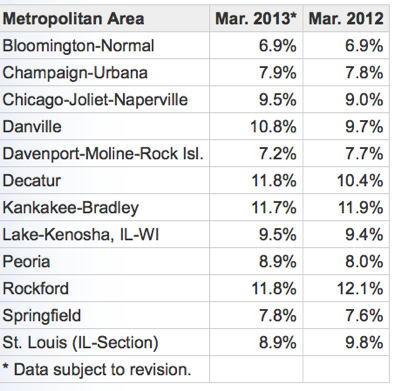
CHICAGO - March local unemployment rates increased in seven of 12 metro areas, decreased in four, and were unchanged in one compared to last year, according to preliminary data released today by the Illinois Department of Employment Security (IDES). Not seasonally adjusted data compares March 2013 to March 2012.
The largest increases were in: Decatur MSA (+1.4 points to 11.8 percent), Danville MSA (+1.1 point to 10.8 percent), and Peoria MSA (+0.9 point to 8.9 percent). The Chicago-Joliet-Naperville Metropolitan Division was up +0.5 point to 9.5 percent. The largest decreases were Metro East (-0.9 point to 8.9 percent) and Quad Cities (-0.5 point to 7.2 percent).
Bost said the Legislature has put money in the budget for the center, but Gov. Pat Quinn still refuses to keep the Murray Center open.
“The Governor has never visited the center,” Bost said. “We are still trying to do everything we can procedurally to keep it open. These are our most vulnerable citizens. It’s awful what is happening.”
“The Governor is a politician and fake,” Bost continued. “I appreciate him showing up at veterans funerals. It’s easy to show care and compassion in a situation you have no control over. In this case, he has the control. It flies in the face of sincerity on other issues.
“If he is so compassionate, why doesn’t he just walk in the facility? If he had been there first, he may have understood the need. It’s heartbreaking.”
* The AP follows up on a story that first appeared here yesterday…
Illinois Gov. Pat Quinn wants Attorney General Lisa Madigan to drop a lawsuit over back pay for unionized state workers so he can implement a new state contract he says will save hundreds of millions of dollars.
But Madigan’s office said Thursday the attorney general won’t dissolve the legal action until her lawyers know whether lawmakers will put up $140 million to pay the back wages that are at the center of the wrangling. If there’s a hang-up in the General Assembly, the attorney general needs to keep legal options open, spokeswoman Natalie Bauer said.
Quinn and the employees’ union settled the dispute at the bargaining table, and his assistant budget director, Abdon Pallasch, said prolonging the lawsuit holds up $900 million in health care savings. The union won’t sign the contract its membership ratified until the lawsuit is pulled off the docket.
Madigan, a Chicago Democrat like Quinn, is considering opposing him in the gubernatorial primary next spring, but officials were careful Thursday to stress the lawsuit is not a question of political ill will. […]
Quinn wants to put the rancor behind him now, particularly with election season approaching, but also because there are savings to be had. While he gave up the fight over the raises, Quinn is eager to realize the health care savings from current and retired state workers in the newly ratified pact, Pallasch said.
“Failing to resolve the $64 million lawsuit now risks the $900 million in health care savings for taxpayers under the contract,” he said.
This is a real standoff. Right now, it doesn’t look like the GA is in any mood to fund the back pay. So the lawsuit won’t be dropped. But that means the contract won’t be signed. The whole thing could come tumbling down, and might even spark another contract vote.
*** UPDATE *** AFSCME just sent this e-mail to its members…
AFSCME has informed the Quinn Administration that the union is not prepared to sign the new contract without further authorization from the union membership. Your AFSCME Bargaining Committee is convening on Monday to recommend a course of action—and further information will be coming to you soon.
I know that the situation can be confusing and frustrating—especially for those employees who have not received their negotiated raises. However, it’s critical to keep in mind how far we have come by standing together and standing firm.
When the pay raise was initially withheld, AFSCME immediately took the issue to arbitration—and won. When the State appealed that decision to court, the Union battled through all the legal delays and maneuvers and secured a ruling that the contract must be honored. When the state said it had no money to pay any raises, AFSCME’s research turned up tens of millions of dollars which resulted in thousands of employees receiving the wages owed over the past two years and many more in line to receive monies from the funds held in escrow.
We’ve succeeded time and again when others said it couldn’t be done. We’re not going to give up now. We’ll keep on fighting to ensure that justice is done for all members. And if all members stand together, we can succeed once more.
Sincerely,
Henry Bayer
Executive Director
*** UPDATE 2 *** If you click here, you’ll see an amendment to a Speaker Madigan bill filed today by Rep. John Bradley which appears to fund the back pay.
Not all that long ago, DuPage County was about as reliably Republican and rock-ribbed conservative as they came.
Things are changing
For one, it’s not nearly as Republican. Back in the 1998 governor’s race, Republican George Ryan defeated Democrat Glenn Poshard by 104,000 votes in DuPage.
But in 2010, during the greatest Republican landslide since 1946, Republican Bill Brady managed to beat Gov. Pat Quinn by less than half Ryan’s total: 45,000 votes. Barack Obama carried the county in both of his presidential bids.
DuPage used to be dominated by Pate Philip, the no-nonsense conservative former state Senate president. Pate wasn’t much for women’s rights, or civil rights, or gay rights or whatever. Back in those days, whenever you thought of DuPage County, you automatically thought of Pate Philip. He seemed to embody an area built on white and corporate flight out of Chicago.
I tried reaching Pate on Thursday because I wanted to ask him about some new polling I’d seen of his beloved county. No luck. That’s too bad, because I genuinely enjoy talking to him. You always know where you stand with that man, and he always tells you what he thinks.
The We Ask America poll I wanted to talk to Pate about found that a plurality of DuPage County’s likely voters support gay marriage.
According to the poll, 49 percent of DuPagers say lawmakers should pass legislation to allow gay marriage while 45 percent oppose it. The poll of 1,052 likely voters taken April 22nd had a margin of error of plus/minus 3 percent.
The poll found that 62 percent of people aged 18-24 support gay marriage. In fact, every age group backed gay marriage except for senior citizens, who opposed it 55-40.
If you had told me a year ago that a poll could turn up these sorts of results in DuPage, I would’ve thought you were dipping into your medical marijuana stash.
But here we are.
There are those in the Republican Party who say that their setbacks in Illinois are just temporary. The party, they say, needs to stick to its core principles, including its very clear party platform plank opposing gay marriage.
To compromise, they say, is to just become “Democrat Lite.” So, only one Republican state senator voted for gay marriage in February. Just three of 47 Republican state representatives say they’re in favor ahead of a House vote.
Famed political prognosticator Nate Silver projects that national support for gay marriage will continue increasing by 1.5 percentage points per year. If he’s right, it’ll just be a few more months before there’s actual majority support for the issue in DuPage.
Conservatives are, by nature, slow to change. That’s totally understandable. It’s who and what they are. But there’s slow and then there’s political suicide. Eventually, they’re going to have to come to grips with this issue. Their all too often harsh rhetoric is alienating the people they need to get their party members elected.
Pate Philip has been out of power for 10 years, now. I truly miss his straight talk, but his brand of politics was on the way out here even before he retired. These days, it seems as though he lived in another world. The trouble is, too many Republican politicians still live in that world.
But now that more people in Pate’s DuPage County favor gay marriage than oppose it, if the GOP still can’t see the writing on the wall, then they probably deserve whatever’s coming to them
* Let’s start our roundup of Aaron Schock’s decision not to run for governor with the Sun-Times report…
“He said back in the fall he was going to see whether he thought he could do more good running for re-election for Congress or running for governor,” Schock aide Steve Shearer told the Peoria Star late Thursday.
Schock, 31, ultimately decided to remain on Capitol Hill, where he serves on the House Ways and Means Committee, said Shearer, Schock’s chief of staff and campaign manager.
But the young third-term Peoria congressman also faced the reality of a crowded GOP field — and a tough general election race if he prevailed. […]
“Aaron realized he is only 31 and is not willing to risk everything against Rauner’s millions and probably Lisa Madigan,” said one state House Republican familiar with Schock’s thinking.
Had Congressman Schock survived a brutal Republican primary race, he still would have faced the daunting challenge of either facing an incumbent governor, Pat Quinn, or a popular attorney general with a well-known family name, Lisa Madigan. Or even throw in the longshot possibility of running against Bill Daley, former Secretary of Commerce and brother of Chicago’s former mayor, Richard M. Daley. All three would be tough opponents, making this race for governor “mission impossible,” that could have resulted in ending his promising political career.
In February, the House Ethics Committee announced it would continue an investigation into Schock over allegations he sought donations of more than $5,000 per donor to a political action committee. The super PAC backed Rep. Adam Kinzinger, who was running in a House primary against Rep. Don Manzullo. Kinzinger won the March 2012 primary.
At the time, Schock spokesman Steve Dutton said Schock hadn’t done anything wrong and the case was “without merit.”
Shearer said Schock’s increasing seniority in the House after the changeover of members in the previous two national congressional elections was a significant factor in the decision not to seek the governor’s office. Schock is only two seats away from the halfway point of seniority on the powerful House Ways and Means Committee.
Schock also serves on the House Administration Committee and in an advisory role to the House Republican Conference.
* Schock has had a storied career so far, and he’s only 31…
The 31-year-old won an unexpected write-in victory for the Peoria District 150 School Board in 2001 by a 20 percent margin over the incumbent board president while still a student at Bradley University. Three years later he won an equally difficult victory in a majority-Democratic state House district where he served for two terms before running for Congress in 2008.
In the House especially he has proven to be a prolific fundraiser, bringing a host of high-profile speakers to central Illinois including former vice presidential candidate Paul Ryan, House Speaker John Boehner, former Secretary of State Condoleezza Rice, then-President George W. Bush, first lady Laura Bush, former House Speaker Newt Gingrich and former House colleague Allen West.
During the first three months of 2013, Schock brought in just shy of three-quarters of a million dollars to his federal campaign fund, and was sitting on a war chest of about $2.7 million, according to disclosure documents filed with the Federal Election Commission.
He could very well be the future of the GOP in this state.
His decision not to run leaves only one Republican candidate at the moment with access to major campaign cash, Chicago investment mogul Bruce Rauner, though Illinois Treasurer Dan Rutherford has raised some hundreds of thousands of dollars.