A recent poll by RMG Research in the 8th Congressional District shows Democratic Rep. Raja Krishnamoorthi leading Republican Chris Dargis 45 percent to 39 percent with 12 percent undecided. The 400 respondents in the poll also favored term limits and disapprove of President Joe Biden’s job performance.
The unspoken, yet very real concern among some Democrats, is that the party is returning to an unhealthy era of one man control, with Pritzker and his subordinates taking the place of Madigan.
“I guess that remains to be seen and we’ll know fairly quickly, ” said Rep. [Will] Davis. “Not only the effort to raise money but then determining how to spend it. If it’s about supporting incumbent Democrats then we’ll know fairly quickly if there’s going to be a resurgence of dictator-style rule.”
[Former Senate President John Cullerton] sees it differently. “There’s an opportunity for someone who can go out and fundraise legally, a chairman, to go out and make it a national effort to raise money for the Democratic Party in Illinois, ” said Cullerton. “We’ve never done that. When Madigan was chair, he only raised money for House Democrats. This would be for the lower-level candidates – the sheriffs and county clerks in the marginal counties downstate. Robin couldn’t do that legally. So of course Elizabeth’s going to raise more than Robin did. Almost by default.”
I’m guessing that Pritzker isn’t gonna want to be governor for 50 years.
Paul Lange believes someone should always have a choice when they walk into a voting booth.
Lange, 67, is recently retired commodities broker who worked in Quincy but lives near Mendon. He has thrown his hat into the ring to run as the Democratic candidate for Illinois’ 15th Congressional District.
It was a district that wasn’t configured to be favorable for Democrats, who had to cede most of downstate Illinois during the redistricting process. Most of the state south of I-80 now votes Republican.
So Lange is looking for a Rocinante, much less a Sancho Panza. He knows his opponent, Republican incumbent Congresswoman Mary Miller, who defeated Rodney Davis in the June 28 GOP primary, is one hell of a windmill in the bright red 15th District.
“I knew because of this district … I knew it’d be unlikely that another person would step up on the Democratic side,” Lange said in an interview with Muddy River News.
* I think the term for this is perennial opportunism…
Bob Fioretti, challenging Cook County Board President Toni Preckwinkle, apparently on board the Darren Bailey governor campaign joining with Jeanne Ives pic.twitter.com/RonFZXBcZX
— FIRST IN PLAYBOOK: “Famous Friends” country star Chris Young will perform Wednesday afternoon for Illinois Democrats’ unity gathering at the BOS Center in Springfield.
The BOS Center thing is in the morning. Young will be performing at the Governor’s Day event at the state fairgrounds. Show should start at 1 o’clock or so.
* More…
* Chicago aldermen embrace The Great Resignation: “What Mayor Richard J. Daley did was surround himself with 50 aldermen, and he’s in the circle,” said former nine-term alderman Dick Mell. “And all the arrows and slings would hit the aldermen so he could do the big things he wanted to do as the mayor. Now the aldermen all think they’re these great legislators and they’re spending all this time deciding whether Lake Shore Drive should be DuSable Drive.”
In June 2012, I collaborated with public-radio reporter Sarah Koenig on an episode of “This American Life” to blow the whistle on Journatic’s shady tactics. The fallout was instant: The Chicago Tribune and others suspended Journatic or ended their contracts. But Journatic’s canny chief executive, Brian Timpone, didn’t fold; he went underground — rebranding the company multiple times in the process.
A few years ago, Timpone switched gears after hooking up with conservative pundit Dan Proft through the Illinois Policy Institute, a right-wing think tank that then had financial ties to Bruce Rauner, Illinois’ recent ex-governor. The pair began building a mini media empire that intentionally put a conservative slant on backyard journalism — the Sinclair Broadcast Group of local newspapers. (Timpone and Proft did not respond to requests for comment sent by email.)
That mission is accomplished if you look at the sheer numbers. Metric Media boasts that it publishes “over 5 million news articles every month” and claims to be “the largest producer of local news in the United States.” A 2020 New York Times investigation pegged 1,300 news sites with Timpone’s fingerprints on them — far outnumbering those of Gannett, the nation’s largest newspaper chain. But because it’s pink-slime journalism, it’s not all under one banner. Many have been laundered through a web of networks with vague names such as LGIS News Service, the Business Journals and Newsinator.
The People Who Play By The Rules PAC has launched new TV and radio ads, “Summer of Joy – Stop Chicago Violence From Coming To Your Town, Vote NO on JB Pritzker.”
Chicago violence is coming to the suburbs. Pritzker will set free those charged with, among other things: Burglary, Arson, Kidnapping, 2nd Degree Murder, Aggravated Battery, and more. And yet we have Mayor Lori Lightfoot calling it “The Summer Of Joy” in Chicago. It is anything but.
The ads will run statewide and are available on YouTube and the PBR PAC Facebook page.
Chicago Mayor LORI LIGHTFOOT:
“It will be the summer of joy in Chicago”
VO:
Thanks to Governor Pritzker, the lawlessness of Chicago will soon be the law statewide.
JIM GLASGOW, Will County State’s Attorney:
“That law goes into effect, our hands will be tied. All their bonds will be extinguished on January 1st”
BOB BERLIN, DuPage County State’s Attorney:
“We’re going to have violent criminals out on the street.”
VO:
That’s why 100 of Illinois’ 102 Illinois State’s Attorneys oppose Pritzker’s mandatory release of violent criminals. Stop Chicago violence from coming to your town. Vote NO on Pritzker.
–
:60 RADIO SPOT Transcript:
Chicago Mayor LORI LIGHTFOOT:
“It will be the summer of joy in Chicago”
VO:
Instead, the trio of Pritzker, Lightfoot and Foxx have made this another summer of murder, mayhem and chaos.
Mother of murder victim Servando Hamros:
“My granddaughter called me to say ‘help me, my Daddy’s shot.’ And then they executed him in front of her. And then they shot her.”
VO:
Thanks to Governor Pritzker, the lawlessness of Chicago will soon be the law statewide. Pritzker’s so-called “SAFE-T” Act makes Illinois a safe haven for violent criminals. That’s why 100 of Illinois’ 102 County State’s Attorneys oppose Pritzker’s mandatory release of alleged murders, kidnappers and arsonists.
Prosecutors like Will County State’s Attorney Jim Glasgow:
“It’s going to be literally the end of days.”
And prosecutors like DuPage County State’s Attorney Bob Berlin:
“We’re going to have violent criminals out on the street.”
VO:
Stop Chicago violence from coming to your town. Vote NO on Pritzker. Paid for by People Who Play By The Rules PAC
In August of 2021, police say, Brittany Griswold, 35, of Geneseo, was behind the wheel of a stolen vehicle involved in a fatal collision in Rock Island. The head-on crash resulted in the death of Cecilia “Ceci” Nache, 49, of Rock Island.
Griswold was charged with two felony counts of aggravated driving under the influence, reckless homicide and aiding/abetting or possession of a stolen vehicle.
Her bail was set at $50,000, but she was released on her own recognizance. She was freed on a written promise to return, in other words, without posting bond.
Represented by former judge and prosecutor Larry Vandersnick, Griswold did not spend a day in jail. After multiple requests by a reporter for a copy of her jail mugshot, Griswold was fingerprinted and photographed — one year after the crash.
On March 27, 2019, police said, Armand Cannon, 27, of Grand Mound, was behind the wheel of a stolen vehicle involved in a fatal collision in Moline. The crash resulted in the death of Tammy Loos, 51, of Milan.
Cannon was charged with aggravated driving under the influence, aggravated reckless driving, reckless homicide and aiding/abetting or possession of a stolen vehicle.
His bond was set at $250,000. He was assigned a court-appointed attorney.
While Griswold never spent a day in jail, Cannon remained behind bars for the three years it took for his case to go to trial. In May, he was found guilty of all charges. […]
“It seems grossly inequitable that one person walks while the other cannot possibly come up with the cash bail, which the judge must have known, given the defense counsel was appointed,” [Ben Ruddell, director of criminal-justice policy for the American Civil Liberties Union of Illinois, after being supplied with the basic details]. “How much money you have shouldn’t be a factor.” […]
Blanca Leal, one of three sisters of Ceci Nache, who died in the crash with Griswold, said someone from her family had attended every one of the court hearings. They were disappointed, she said, when they learned Griswold never was processed through the jail, and her high-profile attorney was able to get her released without serving a day.
Bail reform may result in pre-trial release of other defendants who face the same charges, Leal understands, but the inconsistent treatment, based on money, is a bitter pill.
* Gov. Pritzker on Friday when asked about the Trump raid…
Well, I’m shocked and dismayed, honestly, that Republicans across Illinois haven’t stood up for law enforcement, haven’t stood up for law and order. And instead are standing with somebody that clearly, there is something afoot here that may lead to a prosecution. It seems like, you know, Republicans say that they’re anti crime. And yet here they are standing up for somebody who seems to have committed one.
On the other hand, there’s a presumption of innocence that the governor also talks a lot about. But he does have some nuance…
Gov. J.B. Pritzker on Monday called on authorities to “quickly and thoroughly” complete their investigation into potential influence peddling involving a police body-camera manufacturer and a state senator who spearheaded a massive criminal justice reform bill approved last year.
The Tribune reported on Monday that state Sen. Elgie Sims, a Chicago Democrat, was approached in the spring by federal authorities looking into whether Axon Enterprise Inc. either directly or through other lobbying entities improperly tried to influence Sims. The criminal justice legislation he championed and was enacted in 2021 included a slew of reforms, including requiring every police officer in the state to wear a body camera by 2025.
“On this matter, I encourage authorities to act quickly and thoroughly and to hold anyone accountable who should be held accountable,” Pritzker said Monday at an unrelated news conference on Chicago’s South Side.
Local Republicans have been fairly quiet so far about the still-unfolding Mar-a-Lago raid. But not the National Republican Senatorial Committee, whose national finance co-chair is Chicago corporado Ron Gidwitz.
In a weekend note to contributors, the fund-raising committee for Republican senators and nominees pushed all sorts of buttons. “Why did the Biden administration’s DOJ raid Mar-a-Lago? This has NEVER happened before, and it’s a DISGRACE,” the fund-raising pitch stated. “Could Biden be using the government power to potentially PUT PRESIDENT TRUMP IN JAIL?”
It continued: “The ONLY way to STOP this potential ABUSE OF POWER is by taking our critical Election Year poll so we can WIN this November and RESTORE TRUMP’S Majority.”
There was no immediate response from Gidwitz to a request for comment.
* Pritzker campaign…
Darren Bailey has spent his entire political career cozying up to Donald Trump, breathlessly repeating his dangerous rhetoric and promising to enact his harmful agenda. As MAGA loyalists at every level of government wage a relentless campaign to delegitimize the Federal Bureau of Investigation following a search of Donald Trump’s Florida home, Bailey must answer for whether or not he believes the FBI should be defunded.
Republicans wasted no time sowing distrust in law enforcement in an attempt to please the former president, and Bailey quickly questioned the department’s motives, demanding the FBI “immediately explain their actions.”
Voters deserve to know: Does Bailey agree with his party’s radical right-wing comments discrediting the FBI?
• Mary Miller’s declaration that “The “Deep State” DOJ hates President Trump because he is an outsider who won in 2016 by attacking the DC Swamp for failing the American people.”
• Marjorie Taylor Greene’s call to “DEFUND THE FBI!”
• Lauren Boebert’s claim that the “Dept of Injustice” Raiding Mar-a-Lago “Is Gestapo Crap”
• Josh Hawley’s demand that “Garland must resign or be impeached. The search warrant must be published. Christoper Wray must be removed. And the FBI reformed top to bottom.”
• Rand Paul’s assertion the FBI may have planted evidence
“Working families deserve better than a MAGA apologist who chooses a twice-impeached disgraced former president over accountability, justice, and democracy itself,” said JB for Governor Press Secretary Eliza Glezer.“Bailey must be honest about his party’s attempt to hinder a federal investigation and come clean about why he is more loyal to Donald Trump than a U.S. institution vital to democracy.”
* DuPage County board chair Republican candidate Greg Hart…
Safety and security from crime is a top concern of voters. That is why I am so honored to earn the endorsement of the Illinois Fraternal Order of Police for DuPage County Board Chairman. The Illinois Fraternal Order of Police is the largest organization of sworn law enforcement officers in the state, and represents over 33,000 active duty and retired police officers.
The Illinois FOP endorsement was given because I fully support our police and the rule of law. My opponent, Deb Conroy, chose to stand with criminals and the radical defund the police movement when she voted for the disastrous SAFE-T Act. The Safe-T Act eliminates cash bail, allowing for the release of violent criminals onto our streets.
DuPage County remains a destination location to live, work, and raise a family because of our safe communities. Keeping our communities safe is my number one priority once elected as DuPage County Board Chairman.
Will you join the Illinois Fraternal Order of Police and help keep this momentum going?
…Adding… Rep. Deb Conroy…
While Greg Hart is trying to exaggerate the facts and scare residents I was doing my job and in a meeting with Director Brendan Kelly and John Thompson discussing the white flag law.
* ILGOP…
In case you missed it, Democrats in the Senate just passed a bill to help bring SOCIALISM to America by hiring OVER 80,000 IRS AGENTS to harass Americans!
Make no mistake, if Democrats continue to hold power, things will only get worse. They’re ready to implement MORE tax hikes, more government regulations, and more attacks on our way of life.
We’re fighting back against Democrats’ extreme socialistic policies. We’re working to build a state and a country where citizens can succeed, but we’re up against a wall.
Democrats are raising MILLIONS and MILLIONS to push the socialist agenda. With the election less than 90 days out, we need to keep up!
Rich, can you RUSH a quick donation before our mid-month deadline so that we can DEFEAT SOCIALISM this November?
The US can never be a socialist country. We’re counting on you to help us out.
* From a US Rep. Jan Schakowsky press release…
For far too long, billionaires have enjoyed their mega yachts and trips to space, while hardworking Americans are left struggling to provide for their families. The Inflation Reduction Act will implement a 15% minimum corporate tax so that our richest corporations start to pay their fair share. The bill will also provide funding for the IRS to go after ultra-wealthy tax evaders and will raise at least $124 billion from these tax cheats. Finally, this bill will not raise taxes on any family making $400,000 or less per year, and there will be no new taxes on small businesses. This bill yet again puts people over politics and finally goes after the super rich and corporations.
Kinzinger was a rare republican critic of Trump during his time in the White House. He says the final fracture, his breaking point, came on Election Night 2020 when Trump called for an early end to the vote count while he was ahead.
“We talk about democracy – Republicans love to talk about the Constitution – and yet we’re openly violating it now,” he said.
An analysis last year of Chicago Police Department deployment data appears to raise questions about whether Chicago police officers are consistently on the street at times when most shootings happen in the city. […]
The separate “GPS Analysis by Time of Day and Day of Week” included a 10-year review of shooting data, which examined days of the week. It showed that on weekdays, shooting incidents peak during the 9 p.m. hour. But on weekends, shooting incidents rise until 2 a.m. and then start declining.
The analysis further examined GPS data for three types of patrol responses in the so-called Tier 1 and Tier 2 districts, where most shootings happen — non-tactical district units, tactical district units and the citywide Community Safety Teams, which were launched by Brown as part of his crime-fighting strategy.
The analysis period was between June 2020 and February 2021. In all three categories, the number of officers working in the field, or on the street, appeared out of sync with the number of shootings on the weekends, according to the report.
The city had 167 carjackings last month, up 11% from last July. There were 149 cases in July 2020 and 53 in July 2019.
City records show that Chicago police have made arrests in slightly less than 7% of this year’s hijackings. The arrest rate for 2021 carjackings is 13%. It’s important to note that arrest rates for previous years are typically higher than current periods because police have had more time to identify offenders and secure charges from the state’s attorney’s office.
In 2021, the Cook County State’s Attorney’s Office approved charges in 75% of the carjacking cases that Chicago police brought in, according to the prosecutor’s office data.
…ADDING… Media advisory…
ADVISORY: 9:15 a.m. Tomorrow Aug. 16
Sen. Villa, Rep. Stava-Murray, Community Leaders, Advocates Attend Public Court Watching in Support of Ending Money Bond
Pretrial Fairness Act is law and will go into effect January 2023
WHO:
State Sen. Karina Villa, (D-West Chicago)
State Representative Stava- Murray, (D-Downers Grove)
Katrina Baugh, The People’s Lobby
George Gutierrez, formerly incarcerated community member
Pastor Nathan Perrin, Lombard Mennonite Church
Reverend Dwight Stewart, United Methodist Church
WHAT:
Elected officials, community members and activists will attend public bond court hearings followed by a press conference where they will discuss their support of the Pretrial Fairness Act, which eliminates money bond in Illinois.
After saying there would be a special session “in the coming months,” it’s unclear if legislative leaders will make that happen.
In July, following the U.S. Supreme Court’s ruling returning the issue of abortion to the states, Gov. J.B. Pritzker, House Speaker Emanuel “Chris” Welch, D-Hillside, and Senate President Don Harmon, D-Oak Park, said they planned to “convene a special session in the coming months.”
“In the coming weeks, as the ripples of the decision to overturn Roe [v. Wade] are felt throughout the nation, we expect to get an acute sense of our needs and how Illinois can play an even more vital role in standing up for reproductive freedom,” the three said in a join statement July 5.
Weeks later, House Democrats announced closed-door working groups with only Democrats discussing a variety of issues, including gun control, social media and mental health. […]
Separately Friday, Senate President Don Harmon’s office said topics are still being discussed and no additional dates, outside of veto session in November, have been scheduled at this time. […]
State Rep. Tim Butler, R-Springfield, last month said he doesn’t think a special session will happen.
“And I think anything they put up on the board they will probably find very difficult to find the votes for,” Butler told WMAY.
It will indeed be difficult finding the votes for bills with immediate effective dates because those will require three-fifth super-majorities in both chambers and that might be cutting it too close for some of the stuff they want to work on.
* Gov. Pritzker was asked about a special session on Friday…
Working groups are hard at work in the House of Representatives, working on various aspects of legislation, working with advocates, listening to them. So, we’re cautiously optimistic that they’ll be able to come up with ideas for us to be able to bring forward in a special session, or in veto session, or some of it may even be in the new year. So that’s essentially what we’re looking at right now. We want to make sure that everybody’s brought together so we have the best legislation put forward possible.
* Thanks to a reader for this photo from Sunday’s India Day Parade and Festival in Naperville. Quite the bipartisan gathering to celebrate India’s independence…
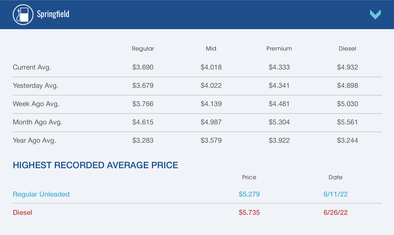
Still struggling with high gas prices? Republican candidate for governor Darren Bailey is offering a chance at some relief.
Bailey plans to give away a $100 gas card each day of the Illinois State Fair to a name drawn from among the people who sign up for the giveaway at the GOP tent on the fairgrounds. Bailey says the giveaway is designed to ease the pain of what he calls Governor JB Pritzker’s “monstrous” 2019 gas tax hike.
That’s when the state enacted a higher gas tax to help fund road and other infrastructure projects.
* In June, Sen. Bailey said he wanted to eliminate the 2019 gas tax increase. WMBD…
In 2019, the gas tax doubled and now sits at 39 cents per gallon. Bailey said the first step toward relief is cutting out the taxes that he said are exacerbating the problem.
“We should permanently roll back the J.B Pritzker, Avery Bourne gas tax. But if we can’t do this, we should at minimum eliminate the sales tax on motor fuel. Friends here in Illinois, we tax tax,” Bailey said.
Bailey said he wants to get the message out to the public, so they will contact their local lawmakers and urge them to get to Springfield and work on the problem
Beginning July 1 and continuing through the end of the year, the motor fuel tax will remain at 39 cents for gasoline and 46.7 cents for diesel. Had the tax increase not been suspended, it would have increased to 41.1 cents for gas, per the rules put in place by the 2019 doubling of the tax.
The ongoing uproar over Darren Bailey’s 2017 claim that the Holocaust “doesn’t even compare on a shadow” to the lives lost to abortion reminded me of a scene in an old movie called “A Bronx Tale.”
The claim Bailey made on Facebook exploded into view courtesy of a brutal TV ad by Gov. J.B. Pritzker’s campaign. The ad begins with an announcer previewing an already-used video clip of Bailey saying he would not allow a woman who was raped or a victim of incest to have an abortion.
“You may have thought you heard everything that Darren Bailey had to say about abortion,” the voice-over person says before the clip is played. “But that’s not all Darren Bailey has said,” the person continues as the newly unearthed clip is shown to viewers.
The closing tagline of “Darren Bailey, too extreme for Illinois” is then flashed on the screen. That’s pretty close to the same language used in Democratic ads that aired during the Republican primary.
There are those who say judging from experience, if Pritzker is using something this over the top in August, then oh my goodness he must have some really strong opposition research in store for voters when the campaign cranks up this fall.
That could very well be, and it doesn’t help matters much right now that Bailey’s billionaire GOP primary benefactor Richard Uihlein has not directly contributed any money to Bailey’s campaign since the primary, so attacking when your opponent can’t fight back has its advantages.
Bailey released a response video to another Pritzker TV ad (calling him out for hypocritically taking millions in federal farm subsidies while opposing other government social programs) that has so far received views in the hundreds, not the millions who would see something on TV.
Either way, this is a true political beat-down. And it didn’t stop there. Bailey at first walked his comments back by saying, “The Holocaust is a human tragedy without parallel. In no way was I attempting to diminish the atrocities of the Holocaust and its stain on history. I meant to emphasize the tragedy of millions of babies being lost.”
Then, the very next day, Bailey told Fox 32’s Dane Placko his words were “taken out of context as they typically are” and blamed reporters.
Then, Bailey was asked by a Fox Valley radio station host if he needed to apologize. Instead of doing so, Bailey laughed and said, “The Jewish community themselves have told me that I’m right,” and he went on to claim “the Jewish rabbis” he’d met with had told him he was “actually right.”
Bailey inexplicably kept the story alive, and Pritzker took full advantage, pounding away at his opponent every chance he got. And since then, the Pritzker campaign has piled on by providing some opposition research to reporters about other Bailey Facebook posts.
The Illinois Muslim Civic Coalition recently issued a press release complaining that “Multiple social media posts by gubernatorial candidate Darren Bailey and his wife are Islamophobic, antisemitic, and xenophobic.”
And that brings me back to the movie, which follows a young Italian-American boy as he learns life lessons from those around him, including from some mobsters.
In the scene, a biker gang known for busting up bars unwittingly walks into a mob-owned bar and, after being told they could stay for a couple of beers, begins to cause trouble. The top mob boss tells the bikers to leave. After being rudely rebuffed, he quietly walks to the front door and locks it, then turns around and faces the bikers: “Now youse can’t leave,” he says.
The mob boss’ underlings immediately stream in through the back door brandishing baseball bats, pistols and other implements of destruction and absolutely pummel the bikers, who are then dragged outside and beaten some more, including by bystanders.
And that’s basically how the rest of this campaign is going to go, even when/if Bailey’s coffers are replenished. Pritzker never took his foot off of Bruce Rauner’s political throat four years ago even though he was way ahead in the polls, and he kept whacking Richard Irvin long after Irvin was clearly no longer viable in the recent GOP primary.
It’s just how they roll over there. Toss in the fact that Pritzker helped found a Holocaust museum and abortion rights is an issue that appears to animate him, and you can understand the desire to go all-out on this one.
* Related…
* State Week: Online posts keep Bailey on the defensive
What could add even more to the fund is passage of HB 4118, sponsored by @RepHalpin … HB 4118 would send $200 million into the fund at the end of each fiscal year or whatever is necessary to ensure the rainy day fund is 5% of the state budget. #twillhttps://t.co/3vHdQ2iITJ
Amends the State Budget Law of the Civil Administrative Code of Illinois. Provides that “general funds” or “State general funds” as used under the Act includes the Pension Stabilization Fund. Amends the State Finance Act. Provides that for fiscal year 2024 and subsequent fiscal years, any transfers into the Budget Stabilization Fund may be transferred to the General Revenue Fund in order for the Comptroller to address outstanding vouchers, and shall not be subject to repayment into the Budget Stabilization Fund if the bill backlog as determined by the Comptroller on June 30 of that fiscal year exceeds $4,000,000,000.
If the amount of the backlog of bills reported by the Comptroller on June 30, 2023 and each June 30 thereafter is an amount less than $3,000,000,000, on the last day of each month of the next fiscal year, or as soon thereafter as possible, the Comptroller shall order transferred and the Treasurer shall transfer from the General Revenue Fund to the Budget Stabilization Fund the lesser of (i) $200,000,000 or (ii) the amount necessary to maintain resources in the Budget Stabilization Fund that is equal to 5% of the total general funds revenues of the prior fiscal year, in equal monthly installments.
This is Reagan’s original rendering. I think she was in high school when she did it. Figured it was relevant for the Pork Patio lol pic.twitter.com/MhzvVQ1pLU